


Cyperus involucratus Seeds | Dwarf Papyrus
LATIN NAME: Cyperus involucratus
COMMON NAME: Dwarf Papyrus, Umbrella Plant
Plant Profile
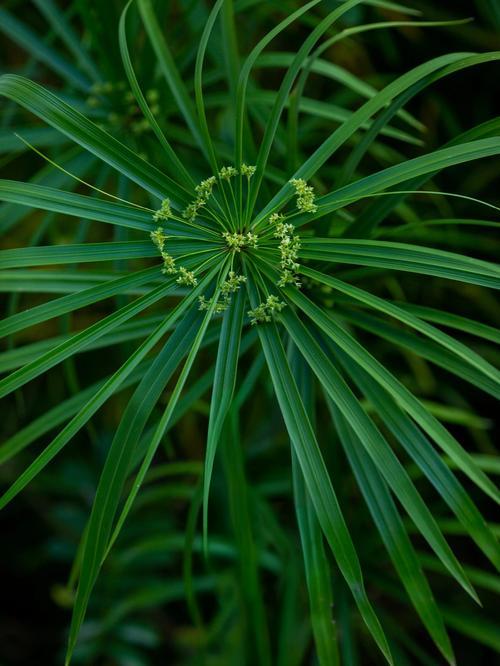
Umbrella plant is an East African sedge with a whorl of leaf-like bracts at the top, and it has escaped into wetlands worldwide. It grows along streams, in marshes and on the edges of swamps in East Africa, the Arabian Peninsula and Madagascar, and it has been carried around the tropics as an ornamental until it now naturalises in Florida, California, Hawaii, Australia and southern Europe. The plant forms a clump of triangular green stems up to a metre and a half tall, each topped by fifteen to twenty flat bracts arranged like the spokes of an umbrella. The true flowers are tiny and brown, crowded in a cluster at the centre of that whorl, and the bracts do the work of photosynthesis. It spreads by short rhizomes and by seed, and in warm wetlands it can form dense stands that crowd out everything else. It is one of the most common pond plants in the world and one of the most persistent.
Science & Biotechnology
Cyperus involucratus is a sedge, and what look like leaves are actually bracts: the true leaves are reduced to sheaths at the base of the stem. The umbrella arrangement is a pseudanthium, a false flower, in which the bracts spread horizontally to catch light while the real inflorescence sits at the centre, and the whole structure is held above the water on a triangular stem that resists bending. The plant is a C4 species with the Kranz anatomy typical of that pathway, which lets it keep growing at high temperatures when other wetland plants slow down. Its seed is small and buoyant and can travel on water and on birds, and the rhizome fragments readily, so a single plant can start a new stand from a piece the size of a thumbnail. The species is a serious invader in warm wetlands, where it forms monocultures that reduce habitat for waterbirds and block drainage channels. It is also tolerant of poor water quality, which is why it survives in polluted canals.
Uses & Benefits
The plant is grown as an ornamental for ponds, bog gardens and indoor bowls, and it is one of the few houseplants that will sit in a saucer of water indefinitely. The stems are used for weaving mats and baskets in East Africa, and the whole plant is harvested for mulch and compost. It has been planted in constructed wetlands for wastewater treatment, where its fast growth takes up nitrogen and phosphorus, though the harvest must be removed or the nutrients return. In folk medicine the rhizome is used for stomach complaints and the pith for eye problems. It is also a useful indicator of wet ground in the garden, since it will not grow where the soil dries out. The drawback is its vigour: in a warm climate it seeds into every damp corner and is difficult to remove once established.
Growing from Seed
Sow seed on wet mud or on the surface of a pot standing in water, at 20 to 25 degrees; germination is fast and the seedlings grow quickly. Division is easier: split a clump in spring and pot the pieces into wet loam, keeping them shallowly submerged. Grow the plant in full sun or light shade, with the roots permanently wet; it will tolerate up to 20 cm of water over the crown. In cold climates lift the pots before the first frost and keep them frost-free and moist through winter, or grow the plant as a houseplant in a sealed pot. Feed lightly in summer, and cut old stems to the base in spring. Remove flower heads before they set seed if the plant is near a natural watercourse, and never dump surplus plants in a river or pond.
Our Take
A pond plant with a perfect green umbrella on every stem, and a bad habit of escaping. Keep it in a pot, and deadhead it.
Related Reading
Gardeners who grow Dwarf Papyrus often pair it with these related subjects: