


Manglietia fordana Seeds | Chinese Manglietia
LATIN NAME: Manglietia fordana
COMMON NAME: Chinese Manglietia
Plant Profile
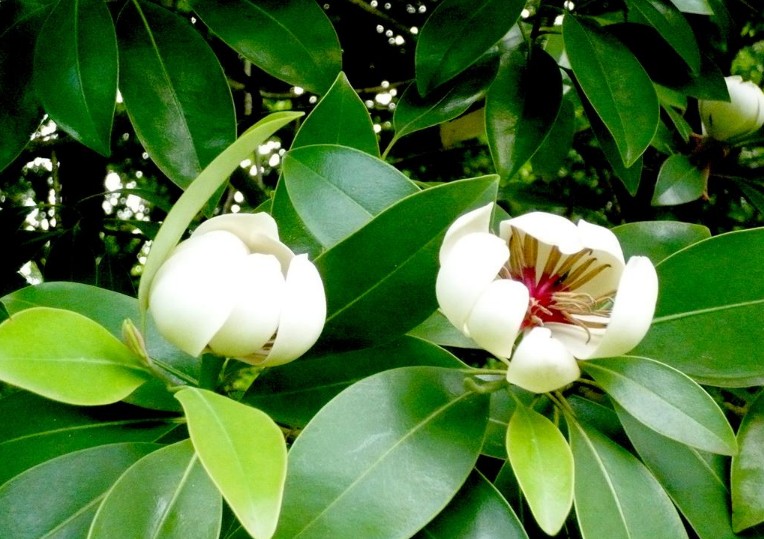
Look into a young bloom and the layout is strikingly archaic: sepals, petals, stamens and carpels follow one another in spirals rather than fixed whorls, and there is no deep tube for a hovering pollinator. Each cup opens with its stigmas already ripe while its own anthers remain shut, so a crawling beetle finds fresh stigmas and no loose pollen. Once the stigmas wither, the anthers split and dust the visitor for the next flower. This protogynous sequence is the family’s old defence against self-pollination.
The fruit is an upright cluster of woody follicles, and when each one splits along its back in autumn, the single seed inside does not simply drop. It hangs out of the open follicle on a thin funicular thread, swinging like a small red bead above the branch. The bright outer coat is a fleshy, oily sarcotesta, and the birds that swallow it do the tree’s long-distance sowing. Gardeners collecting seed should strip that red coat and rinse the pale, bony kernel underneath before it ferries mould into the seed tray.
The genus honours the Italian physician and naturalist Giovanni Mangili, and the species itself was described by the English botanist Daniel Oliver. For a century botanists gathered dozens of Asian species under Manglietia, but molecular work has since shown that most sit comfortably inside Magnolia, and the majority have been transferred to section Manglietia. Herbarium sheets and nursery catalogues still travel under the old label, so both names move together on this tree. The lineage itself is genuinely ancient: magnolia-family pollen ranks among the oldest reliably identified from flowering plants, and the family once spanned Europe and North America before the ice ages cut it back to Asia and the Americas.
Science & Biotechnology
Crush a manglietia leaf and the aroma that rises is a terpene story. Studies across the genus describe volatile oils rich in sesquiterpenes, the heavy, resin-sweet compounds that give magnolia flowers their depth. The wider family supplies the celebrated bark lignans magnolol and honokiol, investigated for anti-inflammatory and antimicrobial activity, and the Chinese manglietia shares that chemical toolkit even though its own bark has never become a trade commodity. The red seed coats are oily as well — soft, unsaturated fats that smell faintly of crushed leaf, a reminder that a dispersal reward is still a chemical contract.
Magnoliaceae set seed irregularly in cultivation, which is why tissue culture has become the family’s safety net. Protocols from axillary buds and juvenile leaves have been worked out for relatives such as southern magnolia, Magnolia officinalis and various Michelias, and the same techniques are being applied to threatened manglietias for conservation planting. A home grower needs none of that: fresh seed, shade and patience, because a young tree may spend its first seasons building roots before showing any ambition upward.
Uses & Benefits
In the cities of Guangdong and Fujian this is a quiet evergreen avenue and park tree, casting steady shade from a dense crown and never littering heavily. Gardeners in mild, humid climates value it as a background tree behind camellias and maples, its cream cups showing well against fresh foliage in spring. The pale, light wood serves local carpentry where the tree is grown, but its real horticultural pull remains the pairing of spring bloom and autumn’s red beads.
Growing from Seed
Treat the seed as fresh as you can. Strip the sarcotesta, rinse the kernels clean, and either sow at once or hold them in barely moist vermiculite in cool storage over winter. Sow about two centimetres deep in an open, humus-rich mix — leaf mould and coarse sand works well — and keep the trays in a shaded frame that never dries completely. Magnolia-family kernels dislike both souring and baking; cool, moist and airy is the target. The seed leaves are broad and entire, and the first true leaves already show the glossy, obovate shape that will define the tree.
Move seedlings into individual pots once they stand a hand’s height, and set them out when roughly half a metre tall on a firm stem. Choose deep soil that holds moisture, with some afternoon shade, since young manglietias scorch in reflected heat. Mulch widely, water deeply through dry spells, and expect a slow, upright crown that asks for little beyond patience.
Our Take
If the spiral-flowered, beetle-serviced blueprint of this tree appeals, the whole magnolia family rewards exploring: the glossy-leaved southern magnolia, the vast-leaved Magnolia delavayi of Yunnan, and the shrubby Michelia yunnanensis all run the same ancient program at different sizes.
Related Reading
Continue exploring with these related plants: