


Ocimum basilicum Seeds | Magical Michael Basil
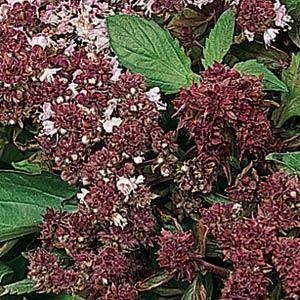
LATIN NAME: Ocimum basilicum
COMMON NAME: Sweet Basil
Plant Profile
Magical Michael is one of the purple-leaved sweet basils, a cultivar grown as much for its ruffled, wine-coloured foliage as for the kitchen. The purple hue is not a trick of light but a real load of anthocyanin pigments in the leaf, the same class of compounds that colours red cabbage and blueberries. That pigment, laid over the usual basil volatile oil, gives the plant its dual life as an ornamental edging and a culinary herb.
Like all sweet basil, ‘Magical Michael’ is a tender aromatic annual with square stems, opposite ovate leaves, and terminal spikes of small two-lipped white to pink flowers. In this cultivar the leaves are broad, slightly cupped, and deep purple, often with a metallic sheen, while the stems take on a matching maroon tint. Glandular trichomes on the leaf surface hold the essential oil that gives basil its familiar scent.
Compared with the leggier forms of sweet basil, ‘Magical Michael’ stays relatively compact and upright, holding its colour well through the heat of summer when some purple basils fade. The flower spikes, though attractive to bees, should be pinched early if the goal is leaf, since flowering shifts the plant’s energy away from foliage and can coarsen the flavour.
Science & Biotechnology
Sweet basil oil is typically built on linalool and eugenol, with methyl chavicol (estragole) and methyl cinnamate present in varying amounts depending on the chemotype. ‘Magical Michael’ carries the sweet-basil volatile profile while adding leaf anthocyanins, chiefly cyanidin-type pigments, that account for the purple colour. Rosmarinic acid adds to the antioxidant load.
Basil is readily micropropagated, and researchers have used genetic transformation and metabolic studies to examine how the phenylpropanoid and anthocyanin pathways produce both the purple pigment and the aromatic compounds. Such work explains why some purple basils keep their colour under heat while others fade, a trait breeders select for. Pharmacological studies note the antimicrobial and antioxidant actions of basil volatiles, largely from eugenol.
The purple pigments are stable in the live leaf but can leach or fade during drying and cooking, so for the deepest colour harvest young leaves and dry them quickly out of bright light. In the garden the plant earns its keep as a companion: its flowers draw bees and predatory wasps, while the aromatic foliage is thought to confuse some pest insects. The flavour stays closest to classic sweet basil despite the colour.
Uses & Benefits
The purple basil group traces to breeding work on anthocyanin-rich sweet basil, the best-known earlier member being ‘Dark Opal’, released by Rutgers University in the 1950s as a culinary and ornamental line. ‘Magical Michael’ belongs to that purple lineage rather than to the Thai or holy basils; it differs from Thai basil (Ocimum basilicum var. thyrsiflora), which is anise-scented with purple stems, and from holy basil (Ocimum tenuiflorum), a distinct species used in South Asian ritual.
The leaves go into pesto, salads, tomato dishes, and herb vinegars, and their colour stains rice and oils a soft violet, a nice touch for presentation. They pair with tomato, garlic, and olive oil as classic sweet basil does. In the ornamental bed the plant serves as edging, container filler, or a focal clump, and the flowers draw bees and butterflies.
Purple basil makes a striking vinegar and a vivid pesto whose colour deepens with the leaf load; pair it with lemon and pine nuts, or stir the chopped leaves into soft cheese for a visual lift. Because the pigment is water-soluble, expect it to tint anything moist it touches, which is part of the fun. The plant also performs well in containers, where the warm root run and sharp drainage suit it, and a single pot by the kitchen door keeps the leaves within reach of the cook.
Growing from Seed
Basil is frost-tender and wants rich, well-drained soil and full sun with warmth. Sow after the soil has warmed, press the seed in lightly, and thin or space plants to 20 to 30 cm apart once they hold two or three true leaves. Keep rows about 30 cm apart.
Water to keep the soil evenly moist but avoid wetting the leaves, which invites mildew, and pinch the growing tips regularly to force branching and to delay flowering so the plant keeps producing tender leaves. In cool climates treat it strictly as an annual or lift a pot indoors. Watch for Japanese beetles, aphids, fusarium wilt, and downy mildew, the last favoured by humid, crowded conditions.
Our Take
I grow ‘Magical Michael’ in a terracotta pot by the door so the purple leaves double as decoration, and I keep sweet basil and Dark Opal basil nearby for comparison. For a varied basil bench add Italian large-leaf basil and cinnamon basil.
Related Reading
Gardeners who grow Sweet Basil often pair it with these related subjects: