


Liriodendron tulipifera Seeds | Tulip Tree
LATIN NAME: Liriodendron tulipifera
COMMON NAME: Tulip Tree, Tulip Poplar, Yellow Poplar
Plant Profile
Stand under a tulip tree and look up: every leaf appears to have had its end sliced away with a blade, leaving two lobes on either side of a flat, notched top. No other common tree in the temperate north has a leaf quite like it, and the shape is so distinctive that a child can identify the species from a single fallen leaf. The golden autumn colour is clear and brief.
What follows is not a cone in the conifer sense but a tight, candle-shaped aggregate of many samaras, each a small one-seeded achene fitted with a narrow wing. The structure dries brown and stands upright into winter, then breaks up progressively: the axis persists as a pale spike while the winged seed spins away on the wind. Collectors watch for the moment it begins to shed.
The species grows best in the deep, moist cove soils of the southern Appalachians, where it can reach well over forty metres with a straight trunk clear of branches for much of its length. In the open it becomes a broad-crowned shade tree; in forest it is one of the fastest-growing hardwoods of eastern North America.
The genus is disjunct: one species in eastern North America and one in central and eastern China, separated by the whole of the Pacific and by tens of millions of years of independent evolution. Comparing the two genomes is a way of asking what a shared ancestor looked like and what a long separation does to tree form and cold hardiness.
Science & Biotechnology
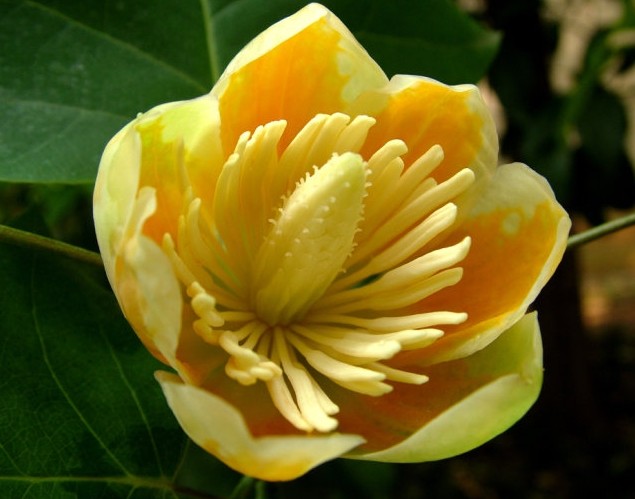
The flowers are large and goblet-shaped, greenish-cream with an orange band inside the base of the petals, and they sit high on the tree where most people never see them properly. Each flower opens as a female, with the stigmas receptive before its own anthers shed, and later becomes functionally male. That sequence, called protogyny, forces pollen to arrive from another flower and is why a solitary tulip tree sets poor seed.
The tree’s chemistry is unusually rich for a temperate hardwood. Liriodenine is an aporphine alkaloid found in the bark and wood; lipiferolide is a sesquiterpene lactone isolated from the leaves; and liriodendrin is a lignan that takes its name from the plant. All three have been studied beyond the chemotaxonomy shelf, liriodenine for antimicrobial and cytotoxic activity among them.
Uses & Benefits
Because the flowers are rich in nectar and borne in enormous numbers, the tulip tree is one of the great honey plants of the southern Appalachians. The honey is dark amber and mildly minty, and it granulates slowly. Beekeepers in its range rate a tulip year as one of the best on record.
The timber, sold as yellow poplar or whitewood, is soft and straight-grained, and easily worked — the traditional American furniture and cabinet wood, and the reason the tree was cut hard through the nineteenth and twentieth centuries. The inner bark is fibrous, and native peoples of eastern North America worked it into cordage, which is why the species carries names such as canoe wood.
Growing from Seed
The tulip tree is one of the hardwoods on which somatic embryogenesis was worked out, because the tree cannot be propagated from cuttings with any reliability and elite timber selections therefore could not be multiplied. Embryogenic cultures raised from immature seed and maintained in liquid suspension can produce large numbers of clonal plantlets.
Tulip tree seed carries an internal dormancy, so handle it like a wild tree seed rather than a vegetable. Sow it in a flat of two parts sieved compost, one part coarse sand and one part perlite, pressing the winged seed into the surface and covering it by only a few millimetres. Give the flat a cool, moist period before expecting movement, and keep it out of full sun. A frame over the flat holds humidity and stops the compost drying hard.
Lift the seedlings when the first true leaves have opened and the root has made a small ball, and pot them individually in deep containers, because the young tree makes a strong taproot early. Move them up as the roots reach the sides, and plant out only when the stem is thick enough to stand unprotected.
Young tulip trees grow fast and are soft, so stake the first year and give them at least three metres of root run. Deer browse the young stems heavily; a cage or a tube around the trunk is more reliable than any repellent.
Our Take
The tulip tree is one of the few large trees that is worth planting for a single leaf and then justifies the space with its crown, its honey and its timber. If the site is small, plant its Asian counterpart Liriodendron chinense or choose a magnolia instead — the evergreen southern magnolia for presence, or the early-flowering saucer magnolia for a garden scale.
Related Reading
More species in the same orbit as Tulip Tree: