


Coriandrum sativum Seeds | Santo Cilantro
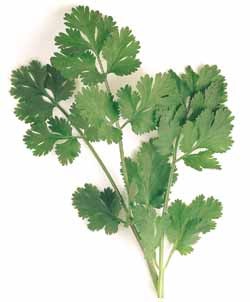
LATIN NAME: Coriandrum sativum
COMMON NAME: Cilantro
Plant Profile
Santo’s leaf smell is built on straight-chain aldehydes, (E)-2-decenal loudest among them, carrying the green, soap-citrus edge that divides dinner tables. The fruit oil runs instead to linalool — the (+)-isomer, called coriandrol — with geraniol and a little camphor behind it. Same plant, same genome, two very different products depending on which tissue you harvest and when.
Market growers favour Santo because it cuts heavy and holds: thick stems, broad basal leaf and honest regrowth after a hard cut. In the kitchen the leaf goes into salsa verde and pico de gallo, chutneys and Vietnamese herb plates; the tender stems carry as much flavour as the leaf, so chop them in rather than picking them out. The root belongs in Thai curry paste, pounded with garlic and white pepper. Seed from your own bolted plants covers curry blends, dukkah and pickling spice for a year.
Science & Biotechnology
In the carrot family’s fruit guide, coriander stands out for shape: a rounded schizocarp that splits into two hemispherical, ribbed mericarps, where dill and carrot set flattened or winged achenes. The small white flowers — sometimes blushed pink — sit in compound umbels that draw honeybees, hoverflies and tiny parasitoid wasps, so the bolting row keeps earning its space even after the leaf crop ends.
Coriander has stood beside juniper as a standard gin botanical for centuries, and it seasons Belgian witbier, Frankfurter sausages and Indian curry blends alike. On the research bench the fruit’s fixed oil, rich in petroselinic acid, keeps drawing oleochemistry interest as a renewable chemical feedstock — a reminder that this kitchen spice is also an industrial crop.
Uses & Benefits
One of the strangest things about coriander is that no one has ever pinned down a truly wild population. The plant is known only from cultivation and its escapes; botanists place its origin in the eastern Mediterranean and south-west Asia — roughly southern Europe, Anatolia, the Levant and Iran — and its fruits have been recovered from Egyptian tombs and prehistoric settlement layers across the region. Every cilantro row in the world descends from an ancient partnership with people.
Greek koris means bedbug, and the genus name remembers it: crush the unripe foliage and you catch the same sharp, rank edge that gave the insect its comparison. The ripe fruit smells nothing like it — full ripeness flips the aroma from aldehyde harshness to warm linalool sweetness, which is why cooks treat leaf and seed as two different spices.
Distillers steam the fully dried grey-brown fruit, and the resulting oil remains a fixture of flavour houses and gin stills. For the kitchen-scale grower the practical version is simpler: toast whole fruit, grind it fresh and keep it airtight — ground coriander loses its top notes to the air far faster than the whole mericarp does.
Growing from Seed
Santo performs best in the cool season. Prepare a light, free-draining bed — two parts loam to one part compost and one part coarse sand suits the taproot — and sow in place about a centimetre deep, rows 30 cm apart. Coriander’s taproot hates the move, so direct sowing beats transplanting every time.
When seedlings show two true leaves, thin to stands about 8 cm apart; a crowded stand bolts early and sheds leaf. Water evenly at the soil line — overhead wet invites bacterial leaf spot — and feed lightly after each cut rather than all at once. Succession-sow short rows for as long as the weather stays cool.
Let a few plants run to umbel at the bed’s edge: the flowers feed hoverflies and parasitoid wasps that then patrol the rest of the vegetable patch, and the browned fruit saves itself for next season. Aphids are the main foliar pest; a firm hose jet and ladybird traffic usually settle them without sprays.
Our Take
Santo is the strain I reach for when a bed has to earn its keep: sow thick, cut heavy, and keep a young row coming on behind the one being cut. Compare it with the Leisure Cilantro Coriandrum sativum ‘Leisure’ strain, or with Longstanding Cilantro Coriandrum sativum for the slow-bolt end of the range; chervil, a milder umbel-leaf cousin for light shade, fills the same winter niche — see Anthriscus cerefolium Root Curled Chervil.
Related Reading
Readers interested in Cilantro frequently explore these as well: