


Isatis tinctoria Seeds | Isatidis Radix
LATIN NAME: Isatis tinctoria
COMMON NAME: Woad
Plant Profile
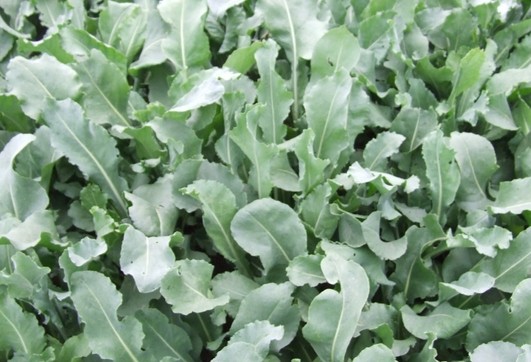
In its first season woad makes no stem at all. It lies flat as a rosette of long leaves, each one coated in a waxy bloom that rubs off grey on the fingers, and it drives a deep fleshy taproot into the ground. That root explains the grower’s rule: sow woad where it is to stand, because seedlings lifted and reset tend to stall or bolt early.
The yellow flowers sit in loose flat-topped sprays, each bloom built on the family plan with four petals in a cross and six stamens, four long and two short. The fruit is more distinctive. It is a flattened one-seeded pod, winged at the edges and hung from a curved stalk, so a seeding plant looks to be carrying a row of small dark spoons.
Woad is a diploid with fourteen chromosomes, and Chinese material was named separately as Isatis indigotica; some botanists keep the two apart, others fold them together. Cultivation followed the cloth trade west and north, and collapsed twice: first when imported indigo undercut the crop, then when synthetic indigo reached the market in the 1890s.
Science & Biotechnology
The leaf holds indican, the glucoside of indoxyl, together with isatan B and a beta-glucosidase. Crush the tissue and the enzyme frees the sugar; the liberated indoxyl meets air and couples into indigo, the blue, with a smaller share of indirubin, the red. The old vats ran the same reaction slowly, using ammonia from stale urine and a bran feed to hold the liquor reducing.
The root, sold as Isatidis Radix or isatis root, carries indigo and indirubin among its constituents, and indirubin has been studied as an inhibitor of cyclin-dependent kinases and of GSK-3 beta. When the 2003 SARS outbreak hit southern China, demand for ban lang gen preparations rose sharply and the habit stayed.
Field material varies too much for careful chemistry, so laboratories grow Isatis in cell suspension and in hairy-root cultures started with Agrobacterium rhizogenes to follow indoxyl production directly. The same reaction has been rebuilt in bacteria: engineered Escherichia coli carrying tryptophanase and a monooxygenase can turn tryptophan into indigo, a route explored as a fermentation alternative to the field crop.
Uses & Benefits
Woad earns its place three times over: as a dye crop, as a medicinal root, and as a plant for a rough sunny corner. Indigo is a vat dye rather than a mordant dye, so wool takes a fast blue from woad without alum or tannin.
Leaves are cut from first-year rosettes and from the second-year plants before the stems run up, then mashed, kneaded into balls and dried for storage before fermentation. The second-year leaf gives the strongest colour, which is why dye growers often keep a bed for two seasons and take a light cut from it in the first.
Woad escapes cultivation easily and appears on noxious weed lists in several western states, so check local rules before sowing near open range or hay ground. On the credit side, the small yellow flowers offer an open landing pad, and bees, hoverflies and the small hunting wasps of high summer work the sprays steadily.
Growing from Seed
Woad wants sun, lime and ground that drains. A raked fine tilth over chalk or limestone rubble suits it, and heavy clay should be broken with grit or grown on a ridge. Sow shallowly, no more than a centimetre under the surface, and firm the soil back over the row so the seed sits in contact with moist ground.
Thin the row to about 30 cm between plants, with 45 cm between rows for leaf yield. Keep the rosettes clear of weeds while they are small, and give a nitrogen-rich feed after each cut to push fresh growth.
Flea beetles riddle seedling leaves with small holes, and the simplest answer is a fleece tunnel over the young row. Clubroot is the serious risk, shared with cabbages and turnips, so keep woad out of ground that has grown brassicas recently and lime any acid patch before sowing.
Our Take
Woad gives a grower a vat, a pharmacy shelf and a bee plant from the same row, so I would start with a short strip rather than a field; the learning curve is in the fermentation, not the soil. For a deeper blue, look at the Chinese woad seed grown for Isatidis Radix; for the dye that eventually displaced it, see true indigo; and for the prepared medicinal root, there is Isatidis Radix root slices.
Related Reading
Readers interested in Woad frequently explore these as well: